

This Week in AI
Four stories actually mattered this week, and two of them are OpenAI trying to outrun itself.
GPT-5.6 and Grok 4.5 dropped on the exact same day. Grok 4.5 landed in Grok Build, Cursor, and the xAI API (no EU access yet), aimed at coding and long multi-step work, while GPT-5.6 arrived with new state-of-the-art coding benchmarks. Two frontier launches, one day — a first for 2026. Read more
Apple is suing OpenAI, and it’s not pretty. Apple took OpenAI to federal court on July 11, accusing it of poaching its silicon, on-device AI, and hardware teams — 400+ former Apple employees now work there. Rough timing, given OpenAI’s reportedly prepping an IPO. Read more
The first fully autonomous AI ransomware attack just happened. Sysdig caught it: an AI agent chain called “JADEPUFFER” handled reconnaissance, intrusion, and payload deployment, even fixing its own bugs mid-attack in 31 seconds — no human touching the keyboard after the initial go-ahead. Read more
OpenAI shipped ChatGPT Work. A GPT-5.6-powered agent that plugs into Slack, Teams, Google Drive, and SharePoint, turning a goal into a finished doc, deck, or web app on its own. It arrives alongside a bigger shakeup: Codex is merging into one ChatGPT desktop app, and the Atlas browser starts getting sunset. OpenAI’s clearest swing yet at Claude Cowork. OpenAI’s announcement
Deep Dive
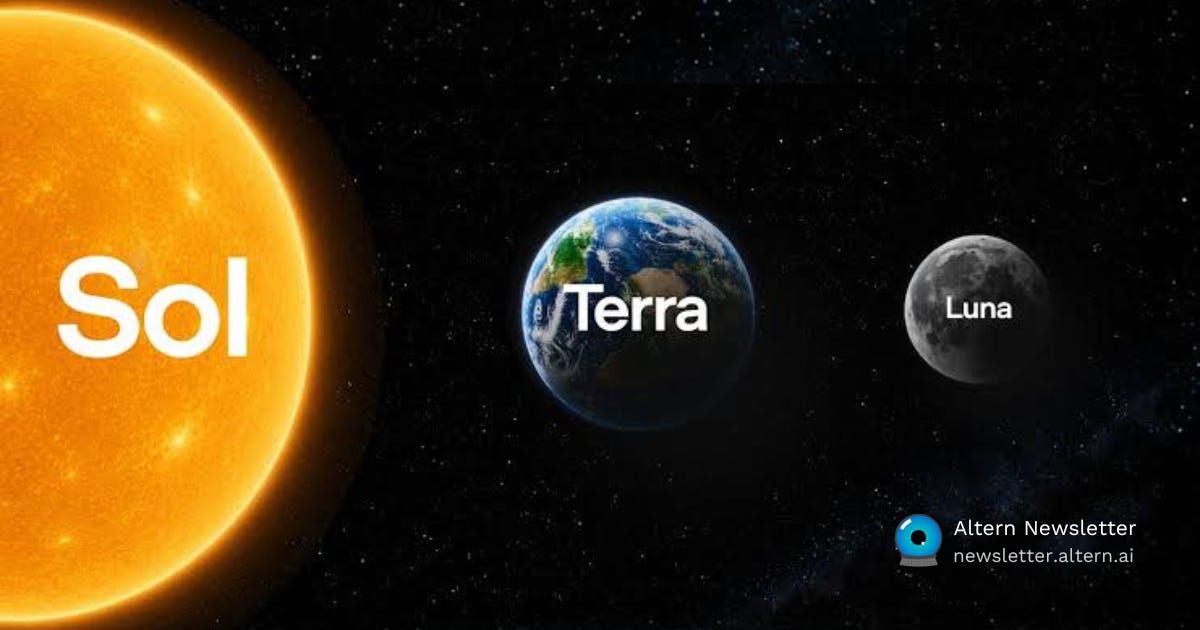
OpenAI finally fixed its naming problem: meet Sol, Terra, and Luna
For years, picking an OpenAI model meant deciphering a soup of suffixes — 4o, o3, 4.5, Instant, Thinking — with basically no intuition for what any of it meant. GPT-5.6 changes that. It’s not one model anymore. It’s three, each with an actual name:
Sol — the flagship. Deepest reasoning, best coding/cyber/science results, and the highest price tag ($5 / $30 per million tokens in/out).
Terra — the sensible middle ground. Roughly GPT-5.5-flagship quality for about half the cost ($2.50 / $15).
Luna — built for speed and volume, and the cheapest of the three ($1 / $6).
Here’s the actual insight behind the new naming: the number tells you the generation, the name tells you the capability tier. So “5.6” is really just a timestamp — it tells you when the thing was trained. Sol, Terra, and Luna tell you how much brainpower you’re paying for. And OpenAI says these three names are meant to stick around across future generations, so don’t be shocked if “GPT-6 Terra” shows up down the line. It’s basically OpenAI arriving, a bit late, at the same idea Anthropic had with Haiku, Sonnet, and Opus.
If you’re building something, here’s the honest way to pick one:
Default to Terra for your main agent loop. It’s the boring, correct choice for most everyday work.
Only reach for Sol when the task is genuinely hard or high-stakes — long-horizon agent chains, gnarly coding problems, security research.
Push high-volume, low-stakes steps (classification, extraction, pre-processing) down to Luna. You’ll barely notice the quality difference and your bill will thank you.
Model IDs, if you’re wiring this up yourself: gpt-5.6-sol, gpt-5.6-terra, gpt-5.6-luna (the gpt-5.6 alias currently points at Sol).
Two places worth a look if you want to go further: OpenAI’s own model guidance page walks through migration and reasoning-effort settings in more depth than the launch post does. And if you’re curious how other developers are already routing between the three tiers, the gpt-5-6 GitHub topic has a growing pile of open-source routers and orchestration projects — genuinely useful for stealing patterns rather than building your own from scratch.
AI of the Week
This week’s picks all share one job: helping you figure out if your idea is actually worth building, before you spend months building it.
Born to Found — an AI tool built to stress-test a startup idea before you invest real time or money into it. Good for the “wait, is this actually good?” gut-check moment every founder hits early.
Siift.ai — calls itself a Founder’s Intelligence Platform, and it earns it: it walks you through ideation, validation, and go-to-market, and builds a strategy canvas tailored to your specific market and constraints rather than a generic template.
Foundra — an AI co-founder purpose-built for validation, running you through a 3-phase process (Spark, Validate, Build) with auto-generated strategy cards, a task planner, and 11 free tools thrown in for pre-seed and seed-stage founders.
That’s a wrap! Explore Top AI tools at Altern, follow us on X, GitHub and LinkedIn, and stay ahead of the AI industry news with the weekly Altern Newsletter at newsletter.altern.ai for the latest updates!